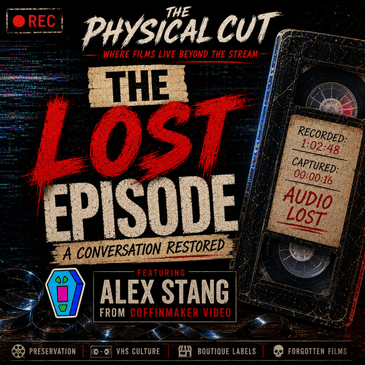

What happens when a conversation about preservation isn't preserved?
In this unique episode of The Physical Cut, Krloz sits down with Alex Stang of CoffinMaker Video to discuss physical media preservation, VHS collecting, boutique labels, forgotten films, and the small businesses working to keep film history alive. But after recording for more than an hour, a technical failure erased Alex's side of the conversation.
Rather than bury the episode, Krloz reconstructs the discussion from the surviving recording and revisits the ideas that made it worth saving.
Together, they explore why physical media still matters in the streaming era, the importance of supporting independent businesses, the joy of discovering forgotten films, VHS culture, film preservation, and the collectors who continue to keep physical media alive.
The episode also highlights Alex Stang's work through CoffinMaker Video, including the preservation and release of cult and lesser-known genre films such as Driller Killer.
Topics discussed include:
• Physical media preservation
• VHS collecting and VHS culture
• Boutique Blu-ray labels
• Forgotten and overlooked films
• Film restoration and preservation
• Supporting small businesses
• Horror films and cult cinema
• Movie collecting in the streaming age
• CoffinMaker Video and independent film preservation
Whether you're a VHS collector, Blu-ray enthusiast, boutique label supporter, or simply someone who believes movies deserve to be owned and preserved, this episode is a reminder that film history is bigger than algorithms and streaming libraries.
Follow Alex Stang and CoffinMaker Video on Instagram @coffinmaker_video
Visit CoffinMaker Video store at coffinmakervideo.base44.app
Follow The Physical Cut: Instagram: @ThePhysicalCutPod
Website: KRPodLab.com
[00:00:00] You're listening to a podcast right now. Driving, working out, walking the dog. If you're into podcasts, chances are you have something to say too. With RSS.com, starting your own podcast is free and easy. Upload an episode and we distribute it to Apple Podcasts, Spotify, Amazon Music and more. Track your listeners, see where they're from and start earning from ads just like this. If you've been thinking about starting a podcast, this is your sign. Start your new podcast for free today at RSS.com.
[00:00:28] This recording should not exist. This is a lost episode of The Physical Cut. Welcome back everybody to a new episode of The Physical Cut, where films live beyond the stream. My name is Carlos and today's episode is a little different.
[00:00:56] I recently sat down with Alex from Coffin Maker Video, a small business focused on preserving physical media, forgotten films, VHS culture and giving lesser known movies a second life. Unfortunately, due to recording issues, all of Alex's audio was lost during the session. Ironically, an episode about preserving physical media was entirely buried by digital failure.
[00:01:23] But the conversation was too good not to save. So today, I wanted to revisit some of the themes we talked about. Physical media preservation, small businesses, boutique labels, VHS collecting and why forgotten films still matter. One of the biggest things that Alex and I talked about was preservation. Not just collecting movies for the sake of owning shelves full of discs, but preserving films that can disappear overnight from streaming platforms.
[00:01:52] Physical media matters to me because it's a, you don't use it, you lose it. Or we, and with that, we're losing a piece of ourselves. And it's not just bits in the airwaves or through the internet to make myself sound old as shit. But it's tangible. But it's tangible, even if it's tangible, even if it's a painting or anything like that. This is something you see and you can touch if you want to feel and then enjoy.
[00:02:22] And with something like streaming. I mean, I stream and stuff, but I try to collect as much physical medias and trying to put out physical media that maybe has been lost, but that's another story.
[00:02:39] But if we don't have it, we're going to lose it. And it's just, there's not much left of us as humans connecting, which is a big part of what I love too, is the connection with humans. And something like a movie, you can sit down with a group of people and enjoy and you make a connection, talk about it. And to me, that's something important.
[00:03:07] I love showing a movie to somebody. I love when somebody shows me a movie. And sometimes there's a movie that I've never even heard of. And for it to not be on a streaming, if it's not on a streaming site, nowadays, some people just never know. So having that piece of physical media is just so important.
[00:03:32] And it's something that we can't lose because if we lose that human connection, then there's really not much else in 2026. And to me personally, that's what's important. It's not so much how clean and crisp and beautiful, for instance, with film. I mean, I love restoring films and restoration is part of an art.
[00:03:56] And to keep it going and to keep it crisp and new, so future generations can also enjoy it. But also, you know, a DVD works just as well or a VHS tape. And sometimes even, you know, the feeling's different from whatever the media source is. That's one of the reasons physical media matters so much to me personally. There's something comforting about knowing a film is actually yours.
[00:04:24] No one can edit it, remove it, license it away, or decide it no longer matters because an algorithm says it doesn't perform well. And honestly, I think people sometimes get too obsessed with formats and upgrades. Just yesterday, I was watching What's Your Number with Anna Faris and Chris Evans. I already know every joke in the movie, but it still cracks me up every single time. I own the Blu-ray, and it looks great. It sounds great.
[00:04:54] And if a 4K release came out tomorrow, I honestly don't think I'd rush to buy it because I'm already happy with the version that I have. Sometimes we forget that the point is the movie itself. There's this weird mindset online where every movie suddenly needs a 4K release to matter. But a lot of Blu-rays still look fantastic.
[00:05:20] A lot of DVDs still hold emotional value. Sometimes the older release itself becomes part of the experience. I even realized while watching the DVD that it came with a digital copy on the DVD. Back when studios basically encouraged you to burn a copy onto your computer. Now, digital ownership feels more temporary than ever.
[00:05:48] That contradiction really stuck with me. One thing I really wanted to ask Alex during our conversation was where the name Coffin Maker Video even came from. Because honestly, it immediately stood out. And that's one of the things I love about the physical media community. Everybody has their own strange little identity, their own niche, their own obsession.
[00:06:16] We're all kind of weird film lovers finding each other through shells of movies and obscure horror recommendations. But Coffin Maker Video specifically stuck with me because it feels like the perfect name for somebody passionate about preserving forgotten cinema. Especially horror. There's something very retro horror about it.
[00:06:41] It sounds like an old underground VHS label you would have discovered hidden in the corner of a video store in the 1980s or even Kin's Video. And I think names like that matter because they instantly tell you there's personality behind the project. It doesn't feel corporate. It doesn't feel like it was generated by algorithm. It feels personal.
[00:07:08] That's something I appreciate about smaller creators and businesses in this space. There's usually a real story behind the branding, behind the collecting habits, behind the movies they choose to preserve. And honestly, the physical media community has always been built on personalities like that. People who care deeply about movies that most of the world forgot even existed.
[00:07:38] I got the name Coffin Maker Video actually quite a few years ago when I was trying to start a little drone, doom, one-man band, instrumental music. Like heavy metal music. And I just thought the name Coffin Maker. And I thought it was a pretty cool name. And I just stopped.
[00:08:03] I didn't stop playing music, but I kind of stopped recording and stuff and went on to later on, a couple years later, I just kind of kept the name. I thought it still sounded cool and kind of like how we were talking about before. It's kind of a name that pops out a little bit. So I wanted it to pop out.
[00:08:27] And my daughter actually kind of gave me the idea of how to design my logo with like the coffin, but a VHS tape with like the retro colors and stuff like that. The more 80s kind of feel to it. So I just thought it was cool, really. And I'm a big metal guy, so it kind of sounds like heavy metal. I do appreciate when somebody says, oh, that's an awesome icon or, you know, cool name.
[00:08:57] I think that's pretty cool because I'm just one regular dude. Another thing we spent a lot of time talking about was small businesses, which was our main theme for this podcast episode. And honestly, I think small businesses are the beating heart of physical media culture. We always say we support boutique labels and independent sellers. But sometimes as a community, we can be a little hypocritical.
[00:09:27] We love shouting out small businesses online, but then we only buy from giant retailers or we only support whatever's trending at the moment. Meanwhile, these small businesses are the ones actually restoring films, preserving obscure titles and taking risks on releases major studios don't care about anymore. And restoration is expensive.
[00:09:55] People complain about boutique prices, but restoring films, especially obscure films, takes time, effort, money, scanning, cleanup, rights negotiations, packaging, manufacturing. It's a massive process.
[00:10:17] We can constantly say we want lesser known films preserved and then refuse to support the people actually trying to preserve them. Small businesses in collecting culture are, to me, they're everything because they bring a real personality. They put in their blood, sweat, and tears into everything.
[00:10:42] And they just, it's just a totally different feeling from buying or from generic store 138. You know what I mean? Whatever, Walmart or something. And when you're helping these small businesses, you're helping the passion for them to keep going. And in turn, that produces higher quality releases and better production. It's an ecosystem circle. You know what I mean?
[00:11:12] It's you give and they give right back. And then you're going to both keep climbing and you're going to get cooler releases. And they'll be able to find things that maybe you only know about. Well, they'll figure it out.
[00:11:27] And something that's obtainable to them, which in turn, they can bring to you to have a physical copy of some crap zombie movie that you saw when you were 14 years old that nobody has ever seen because you found the tape, you know, in a dumpster somewhere. But somehow they, that other person dug in the same dumpster, I guess, and found it. And they don't have the resources when they're real low at starting out.
[00:11:57] But they try their best to put out the most quality because they know in return, you guys, if people support, then it just keeps getting better and better and more quality. And for the most part, these people remember where they come from and they're always going to put their people first. We're all in the same community.
[00:12:20] We all kind of know what we like, even though everybody likes something different, but we still have the ultimate outcome of the collection and, you know, the cool artwork and all that stuff. They can afford a different artist, for example, for the cover art where you get something really cool looking. It's hard to do when you're first starting out. And it's very hard. We've talked about this before. It's really hard. I'm learning all about it because I'm so new.
[00:12:49] I'm still learning how to get better and do better with releases. And it's hard. And when they put in the work, you should support that work because you never know what the next thing might come. It might be something that's really interesting to you. And then that piece of media has now been saved and dug out of obscurity, which is it works for everybody. And then more people find out.
[00:13:17] And now you can have your your group of people again watching the same movie and, you know, laughing or being scared or whatever it is and just enjoying a good film or bad film. What I love about smaller stores and vendors is the personal connection.
[00:13:36] I love walking into small retro shops in New York City and talking to the owners, talking to the people behind the counter, talking to other collectors, discovering movies. I never would have found just scrolling through Amazon. One of those small businesses that stands out in particular is Tommy Figgs. That's located actually here in New York City in the underground market of the Columbus Circle subway station.
[00:14:06] Walking into the store feels like stepping inside a 90s cereal commercial. You're surrounded by retro toys and VHS tapes that instantly transport you back to your favorite Saturday morning cartoon routine. That's real film and physical media culture, at least to me. Not the algorithms, not influencers posting a stack of movies for likes.
[00:14:32] Actual conversations, not just with the Cartarian Bros during July and November. Actual discovery, actual passion. I had mentioned to Alex that one of my favorite parts of collecting is discovering films in the wild. There's something special about judging a movie by the cover, bringing it home, watching it, and suddenly finding a new favorite film you never even heard before.
[00:15:01] That happened to me a lot with older horror films, especially Mexican Gothic horror. When I started discovering films like The Curse of the Crime Woman, I completely fell in love with the style of filmmaking. These movies have visible wires, exaggerated effects, theatrical performances, but that's part of the charm. I always joke that if you give me a flying vampire hanging from a visible wire in a 1960s horror film,
[00:15:30] I'll absolutely take it because there's sincerity to it, there's creativity to it, there's personality to it. And a lot of these films survive today because somebody cared enough to preserve them. A real fun film that I feel like more people should get to know or it's not, you know, the most obscure. You're listening to a podcast right now. Driving, working out, walking the dog.
[00:15:57] If you're into podcasts, chances are you have something to say too. With RSS.com, starting your own is free and easy. Upload an episode and we distribute it to Apple Podcasts, Spotify, Amazon Music, and hundreds more. Track your listeners, see where they're from, and start earning from ads like this. Even with just 10 listeners a month. If you've been thinking about starting a podcast, this is your sign. Start free at RSS.com.
[00:16:26] First thing ever, but it's just a movie that I champion for all the time. And it's called Abbey. And it's from 1974, I believe? 75? It's a blaxploitation horror film, which is pretty similar. But it's still its own movie, but it's pretty similar to The Exorcist, which is kind of why it got where it got.
[00:16:54] It is because Warner Brothers pulled him out once they saw that this movie was actually being successful. So the gigantic corporation tried burying it. And I believe it's only ever made it onto like an official release. I think maybe VHS, maybe DVD. But yeah, the rights are just like, from what I know, I'm pretty sure the rights are just buried.
[00:17:19] But there's so much spirit behind, no pun intended, behind that movie. I really champion that movie for people to know because maybe somebody can grab onto it. And who knows, maybe you could do release it to do an official 4K or whatever kind of Blu-ray. Shoot, release it back on tape again. And that's something that deserves some, it needs to be dug out of, I guess, the hole that it's in.
[00:17:49] Where it's kind of in a rights situation with a huge corporation that's been bought and sold 10 million times since the 70s. So it's literally just another number. It's probably, I don't know where it's at, but I really love that movie, man. There's so much heart to it and it's pretty decent acting for what it is. Please go watch Abby. I love that movie.
[00:18:16] There's two really cool labels I like supporting. And one of my really favorite labels is Video Vengeance because I love all the shot on video stuff. I think that's where people really put their heart into it, even when it's horrible. But I just love what they do because they kind of give those people that had, you know, shot on video.
[00:18:42] Those things really get lost because, you know, kind of similar to Abby. At least it was a semi-major movie at one point, you know what I mean? An independent one. But it's still, you know, some of these shot on video stuff, they just really get lost. These directors, sometimes they just do one film and they don't want to do movies anymore. So they just kind of drop off the face of the earth. I know that because one of the ones that I actually want to release,
[00:19:11] I'm having a very hard time tracking down the director who owns the rights to it. And actually it's taken me quite a while because I'm just a one-man, you know, company right now. It's not, you know, I don't have any pull. I don't know anybody, but I'll say Video Vengeance, they're awesome. You have like Air 4444. They're pretty cool.
[00:19:35] They put out pretty awesome Asian cinema that would really just be lost. They're out of Baltimore. So that's pretty cool too. And yeah, they put out really good stuff. They put it out. They put a lot of time and effort into the releases. So yeah, they're real cool too. That's why I appreciate labels like Melinda Macabro and other boutique companies focusing on lesser known cinema.
[00:20:05] They're restoring movies most people have never heard of, but that still deserves to exist and be rediscovered. That's the beauty of physical media collecting. Finding films nobody told you to watch. We also talked a lot about VHS. And yes, VHS has become more expensive lately because of nostalgia and resurgence culture, but there's still something magical about it.
[00:20:31] There's a feeling to VHS that modern formats can't replicate. The tracking line, the grain, the imperfections, the oversized artwork, the hunt itself. A lot of my VHS collection is tied to movies or directors I emotionally connect with. Sometimes it's not even about the quality of the film. It's about the memory attached to it.
[00:20:59] And I think that's something younger collectors are discovering now. Gen Z collectors are digging through thrift stores and finding DVDs and VHS tapes for a couple of dollars, while a lot of us millennials spend years paying retail prices, trying to keep physical media alive. And honestly, I love seeing younger generations discover physical media one thrift store at a time.
[00:21:25] Because at the end of the day, whether it's VHS, DVD, Blu-ray, or 4K, the important thing is that people still care enough to own films physically. One thing Alex really emphasized during our conversation was giving forgotten films a spotlight. Yeah, I'm definitely behind having every film, for the most part. You know, being able to survive and go on and find new life and new audience.
[00:21:55] Because to me, you know, movies, films are like the ultimate art form. You got music, you've got visuals, you've got even the tangibleness of it. You know, you could see that film grain. But anyways, before I was even starting out, you know, with Coffin Maker Video, one of the seeds that got planted was actually finding a, just what looked like to be a blank tape at Goodwill.
[00:22:24] And I grabbed it and I opened up that case and there was a horribly crappy, blurry looking picture. And the name caught me and it made me laugh. I was like, dude, I got to buy this. Nobody, nobody's ever going to, this thing's going to end up in a landfill because nobody's ever going to get it. And I took it home and me and my fiance, we popped it in one night and we were just laughing because it was, it was a, it's a comedy whore.
[00:22:54] And these guys were like the same age as me, but you know, they were making this movie when they were 17, 18 year old. And it was so confidently put together. It's just so funny. And it had no reason to be that funny and good for what it is. And it's great. And I'm like, some people need to see this film because it's, it's just too good.
[00:23:21] And I know that nobody knows about it because I found it in the bottom of a Goodwill in Delaware. When I actually got to contact this guy, this was later on because like I said, it planted the seed for Coffin Maker Video. For what I really believe in with the company I'm trying to really push and start is one, preservation of films and stuff like that.
[00:23:48] And the community, these things are really important to me. And us having our group of people, you know what I mean? And nobody knows about this. And there's one thing for sure with, with especially horror fans and stuff, they love a good piece of shit movie. And I love them for that. You know what I mean? And, but yeah, that, that, that movie was, I've, I've talked to the director since then and I've actually gotten into contact.
[00:24:18] And we're speaking about, you know, things I would like to release it. And, you know, these are the things of acquisitions and stuff like that. But, you know, we'll see from there, but it was cool. I've found the director. This was the first real big dig that I got to do because the first one, it's led to a dead end. And that kind of bummed me out a little bit because I'm, I'm really new at this. This is all new stuff. Yeah.
[00:24:47] I've gotten into contact with the guy and the director he directed wrote it. He's in it, man. It has no right to be as good as it is. At least to me, who knows? Maybe everybody else would think it's horrible, but I think it's something that needs to be released. And hopefully someday I'll be able to do that if I can keep going with this and everything works out fine. Because that's kind of the movie.
[00:25:17] And I even told the director that, you know, you're the reason I even want to start doing, you know, Calvin Maker video. So we'll see where that goes with that. Not every movie needs to be an Oscar winning masterpiece to matter. Some films are messy. Some are weird. Some are low budget. And some are deeply flawed. But somebody still sat down and created them.
[00:25:47] Somebody wrote them. Somebody filmed them. Somebody believed in them enough to bring them into assistance. And then years later, somebody else decided they were worth restoring and preserving. That deserves appreciation. I think sometimes we spend too much time debating whether a film is important enough. Instead of simply appreciating that it exists at all.
[00:26:15] Because film history is bigger than just mainstream classics. Sometimes the weird little forgotten movie sitting in a bargain bin ends up becoming the one you never stop thinking about. Before we wrap up this episode, I also want to spotlight one of the projects Alex worked on preserving. Driller Killer. Driller Killer. This is exactly the kind of release I think deserves attention.
[00:26:41] Because these smaller VHS releases aren't just products. They're preservation projects. They are labors of love created by people who genuinely care about keeping physical media culture alive. A lot of these films could easily disappear into obscurity if nobody took the time to restore them. Release them. Package them. And physically put them back into collectors' hands.
[00:27:09] And that's what I appreciate about smaller labels and businesses like these. They're not chasing whatever algorithm says is popular this week. They're trying to preserve film history. Especially the weird, the forgotten, the lesser known side of cinema that large companies usually tend to ignore. And honestly, there's something fitting about horror films.
[00:27:37] Specifically finding a second life on VHS. The format itself adds personality to the experience. It feels tactile. Messy. Retro. It feels alive. That's the kind of passion that keeps physical media culture moving forward. I think with the preservation of the VHS format, which is pretty newish.
[00:28:04] Because it's been, what, 20 years since they stopped making them now. And, kind of like how you were saying, I kind of give the later millennials and the Gen Z and stuff, give them a little bit of credit for trying to, they started buying that stuff up again. And it's just gotten more popular. And it's kind of what it is right now. It's just popular. I mean, my first release is VHS.
[00:28:31] Because I was trying to tap into that. So, I could get a little noticed and stuff. VHS is fun. It's much more mechanical than DVDs. In the sense of the sounds. You can hear the gears turning. You know, the tape spinning over. And it running up through the head. I think it's not so much a gimmick now. But it's kind of, maybe it is. I don't know.
[00:29:00] Maybe I'm, maybe I can't think of the right word. But it's a little gimmicky. Because it's fun to put in the VHS. It brings people our age. Mine, I'm 40 years old. And it reminds us of our childhood. And, you know, a lot of people now are into that. Because their childhood, for the most part, was safety. They didn't have to worry about bills. They didn't have to, you know, oil changes.
[00:29:29] Or, you know, car maintenance, I guess. And just the stresses of life. When, you know, we can go grab 1989 Batman. And pop it in. And watch that for the afternoon on a Saturday when we're done playing outside. I think it's a lot to do with people our age. And in the curiosity of the younger generation. Of seeing, because they at least had discs a lot of times.
[00:29:54] But even tapes, like I said, it's been, what, 20 years since they really mass produced them. And even a little bit more than 20 years. I think it's a mixture of all those things together. Which I kind of wanted to do with Driller Killer. And kind of wanted to grab onto that. And it's fun seeing a grimy film. Like something like Driller Killer. Something on, with the lines. You know, scan lines.
[00:30:22] But I really believe it's just kind of a fun gimmick right now. And it'll probably stick around for a long time. Just like retro games have stuck around for the past. The popularity of them for the past 15 years or so. And it's cool. I love VHS. I love collecting VHS. So, yeah. So, even though the original interview was entirely lost.
[00:30:48] I still wanted to save the conversation in some form. Because the ideas behind it mattered too much to disappear. Huge thank you to Alex from Coffin Maker Video for taking the time to speak with me. Please make sure to support small businesses. Support boutique labels. And most importantly, keep physical media alive. You can follow me at The Physical Cut Pod on Instagram.
[00:31:17] And check out all episodes at krpodlab.com. That is krpodlab.com. This has been The Physical Cut. And I will see you guys next time. Leave no proof.
[00:31:49] You're listening to a podcast right now. Driving, working out, walking the dog. If you're into podcasts, chances are you have something to say too. With rss.com, starting your own is free and easy. Upload an episode, and we distribute it to Apple Podcasts, Spotify, Amazon Music, and hundreds more. Track your listeners, see where they're from, and start earning from ads like this. Even with just 10 listeners a month.
[00:32:16] If you've been thinking about starting a podcast, this is your sign. Start free at rss.com. And then, listen to the podcast. I'll see you next time. Thank you.